
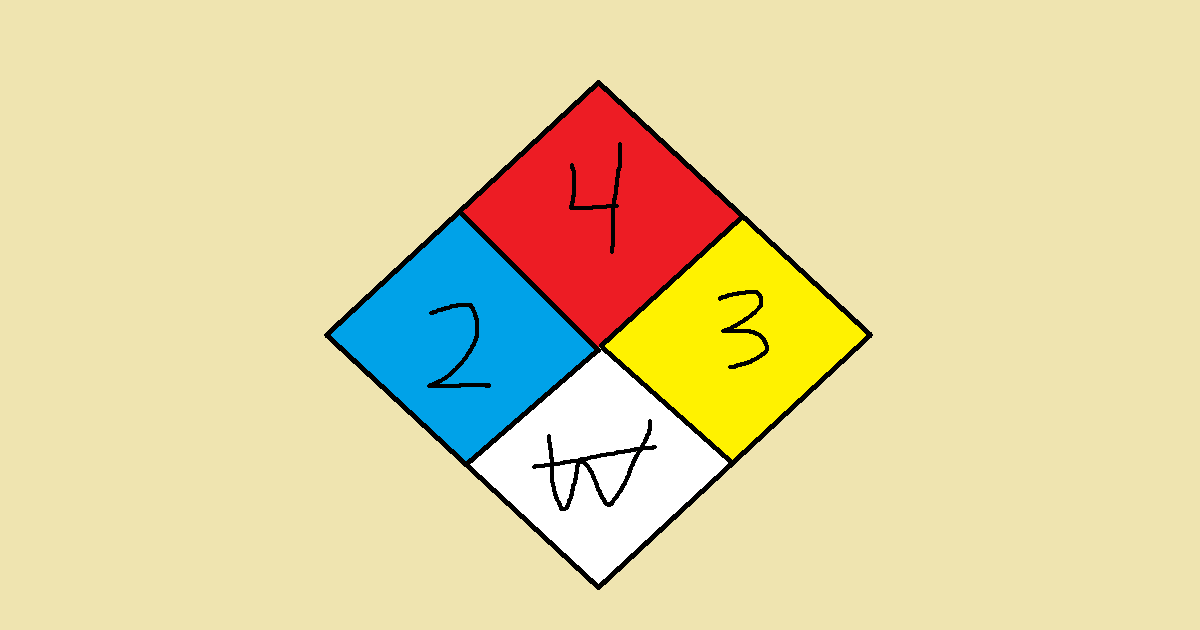

You’ve probably seen them on buildings, SDS, and chemical bottles. They’re everywhere! They’re usually called the NFPA diamond like the one down below but the official standard is NFPA 704. NFPA stands for National Fire Protection Agency.

So why have these placard everywhere? This is to communicate the hazards in each building, room, or chemical. This allows our first responders to understand what the hazards are before attempting to enter the building or extinguish a fire. If a room had a fire started by a water-reactive alkaline metal (i.e., sodium), first responders would not want to start dousing the fire with water.
So what are the numbers? In each diamond there are numbers ranging from 0 to 4, and depending on their number it dictates what their hazard is. Each meaning for the number is different for each color. 0 is little to no hazard while 4 is a severe hazard
| 0 | Poses no health hazard, requires no precautions, and would offer no hazard beyond that of ordinary combustible materials. |
| 1 | Exposure would cause irritation with only minor residual injury. |
| 2 | Intense or continued but not chronic exposure could cause temporary incapacitation or possible residual injury. |
| 3 | Short exposure could cause serious temporary or moderate residual injury. |
| 4 | Very short exposure could cause death or major residual injury. |
| 0 | Materials that will not burn under typical fire conditions, including instrinsically noncombustible materials such as concrete, stone, and sand. Materials that will not burn in air unless exposed to a temperature of 820 oC (1,500 oF) for more than 5 minutes. |
| 1 | Materials that require considerable preheating, under all ambient temperature conditions, before ignition and combustion can occur. Includes some finely divided suspended solids that do not require heating before ignition can occur. Flash point at or above 93.3 oC (200 oF). |
| 2 | Must be moederately heated or exposed to relatively high ambient temperature before ignition can occur. Flash point between 37.8 oC (100 oF) and 93.3 oC (200 oF) |
| 3 | Materials that can be ignited under almost all ambient temperature conditions. Liquids having a flash point below 22.8 oC (73 oF) and having a boiling point at or above 37.8 oC (100 oF) or having a flash point between 22.8 oC (73 oF) and 37.8 oC (100 oF) |
| 4 | Will rapidly or completely vaporize at normal atmospheric pressure and temperature, or is readily dispersed in air and will burn readily. Includes pyrophoric substances. Flash point below room temperature at 22.8 oC (73 oF) |
| 0 | normally stable, even under fire exposure conditions, and is not reactive with water |
| 1 | Normally stable, but can become unstable at elevated temperatures and pressures |
| 2 | Undergoes violent chemical change at elevated temperatures and pressures, reacts violently with water, or may form explosive mixtures with water. |
| 3 | Capable of detonation or explosive decomposition but requires a strong initiating source, must be heated under confinement before initiation, reacts explosively with water, or will detonate if severely shocked. |
| 4 | Readily capable of detonation or explosive decomposition at normal temperatures and pressure. |
| Symbols | NFPA 704 Standard |
|---|---|
| OX | Oxidizer, allows chemicals to burn without an air supply. |
| Reacts with water in an unusual or dangerous manner. | |
| SA | Simple asphyxiant gas. The SA symbol is also used for liquified CO2 vapor withdrawal systems and where large quantities of dry ice are used in confined areas. |
| Symbols | Non-Standard (unofficial) |
|---|---|
| CORR | Corrosive; strong acid or base |
| ACID | Acid |
| ALK | Alkaline |
| BIO | Biological hazard |
| POI | Poisonous |
| RAD | Radioactive |
| CRYO | Cryogenic |
| G OX | Oxygen gas |
Usually, when you see a chemical with 0 across the board then you’re probably working with something fairly innocuous, but something with 4 in each category means stay away!
Let’s look at some examples below:

Woah, Health = 3, Flammability = 0, Instability = 2, and it’s water-reactive and an oxidizer. How scary!

t-BuLi is one scary chemical. It is 4 across the board and it’s water-reactive!!

Acetone is quite flammable with a flash point of -20 oC (-4 oF) and a boiling point of 56.1 oC (132.94 oF)

I would say that propylene glycol is fairly innocuous and I would not be in a rush to go to the hospital if I had gotten some on my arm.
The next time you step into a room or a building that you know holds hazardous materials, check to see what their NFPA 704 looks like.
Leave a Reply